Care-Oriented Robotic Assistant

Embodied clinical intelligence,
at the bedside.

CORA is an autonomous AI-powered bedside assistant that combines robotics, multimodal sensing, and conversational intelligence to support patients and extend the reach of clinical teams.

Alpha
Operational prototype
On-device
Privacy-preserving AI
Autonomous
ROS2 navigation & SLAM
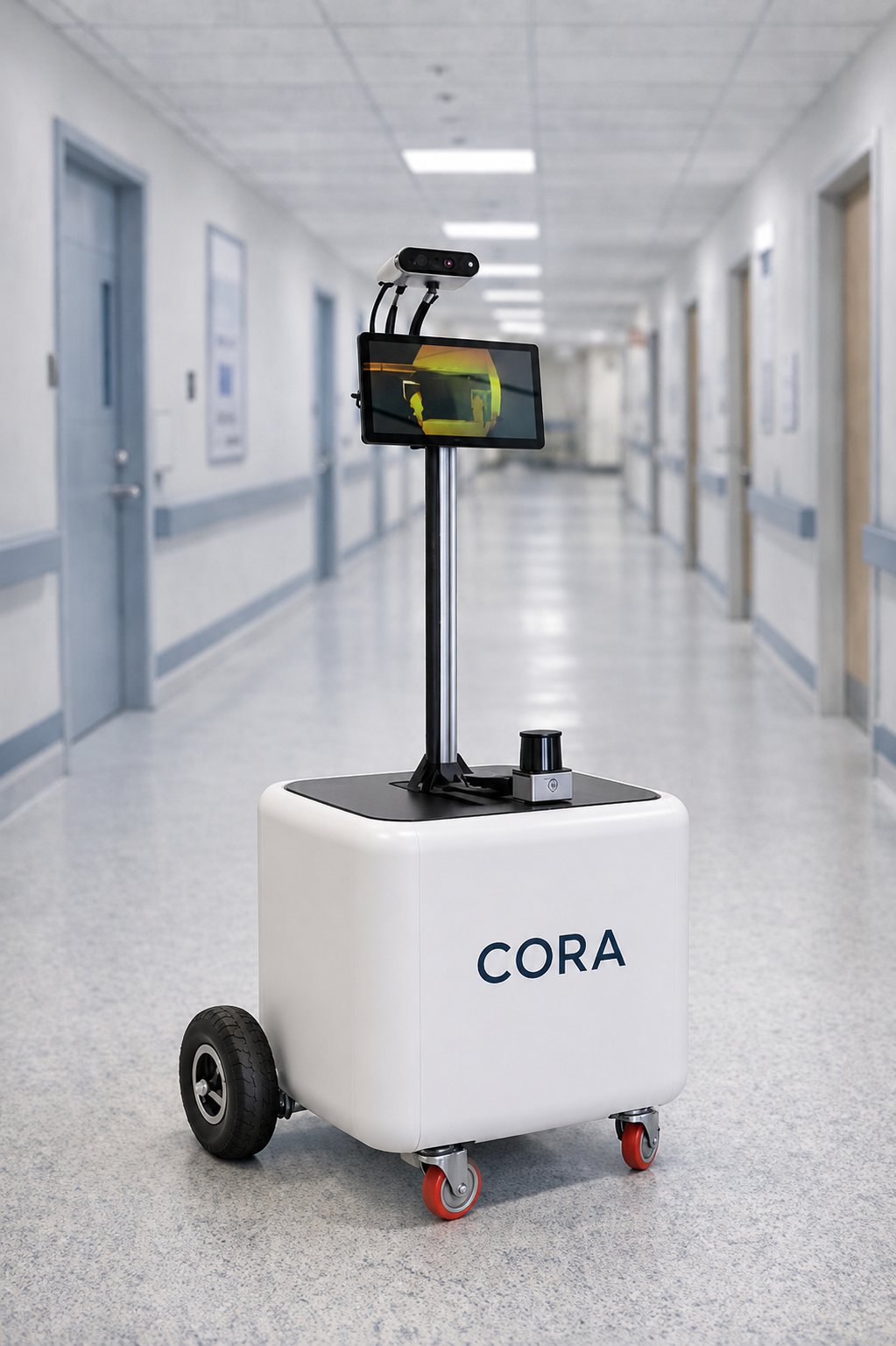
Alpha prototype The CORA robot prototype โ€” a mobile base with an on-device camera and tablet โ€” beside a clinician at the University of Florida College of Medicine
CORA operational prototype ยท UF College of Medicine
The problem

Care teams are stretched thin at the bedside

Workforce shortages, rising patient acuity, and mounting documentation pull clinicians away from patients. Existing tools each solve only part of the gap.

๐Ÿ’ฌ

Virtual nursing

Can communicate with patients, but has no physical presence to act at the bedside.

๐Ÿ“ก

Ambient monitoring

Observes patients continuously, but cannot interact meaningfully or respond.

๐Ÿ“ฆ

Service robots

Navigate clinical spaces to move supplies, but lack understanding of patient condition or context.

๐Ÿ”ฅ

The result

Routine bedside tasks still require direct staff involvement โ€” driving burnout and staffing strain.

The platform

One platform. Perception, mobility, interaction, intelligence.

CORA unifies four capabilities that have never lived in a single clinical system โ€” so it can safely operate in real hospital environments and genuinely assist care teams.

๐Ÿงญ

Autonomous mobility

Navigates hospital environments independently using ROS2-based navigation and SLAM to reach patients when needed.

๐Ÿ‘๏ธ

Multimodal sensing

Perceives its surroundings and patient state through RGB-D cameras, LiDAR, and environmental sensors.

๐Ÿ—ฃ๏ธ

Conversational AI

Engages patients naturally โ€” check-ins, symptom assessment, orientation, education, and communication support.

๐Ÿ”’

On-device intelligence

Runs local large language models on NVIDIA Jetson platforms, keeping sensitive patient data private by design.

Why CORA is different

A new class of embodied clinical intelligence

Where point solutions stop, CORA continues โ€” combining presence, perception, and understanding.

Existing tools can'tโ€ฆ
CORA does
Virtual systems lack physical presence
โœ“Autonomously navigates to the patient
Monitors can't interact
โœ“Converses, gathers info, and educates
Service robots don't understand context
โœ“Understands patient state & workflows
Cloud AI raises privacy concerns
โœ“Processes intelligence on-device
Technology & status

An operational alpha prototype today

CORA has been developed and evaluated in controlled environments, demonstrating reliable navigation, patient-facing conversation, multimodal perception, and privacy-preserving local inference.

ROS2 navigation & SLAM Local LLMs RGB-D cameras LiDAR Environmental sensors NVIDIA Jetson on-device AI
Where CORA deploys

Built for the highest-acuity settings first

Available as a Robotics-as-a-Service platform โ€” hardware, software, maintenance, and ongoing AI updates under an annual subscription.

๐ŸฅAcademic medical centers
๐Ÿซ€Intensive care units
๐Ÿ›๏ธStep-down units
๐ŸฉบInpatient wards
Get in touch

Bring embodied clinical intelligence to your team

We're partnering with health systems and academic medical centers on early deployments. Request a briefing to see CORA in action.